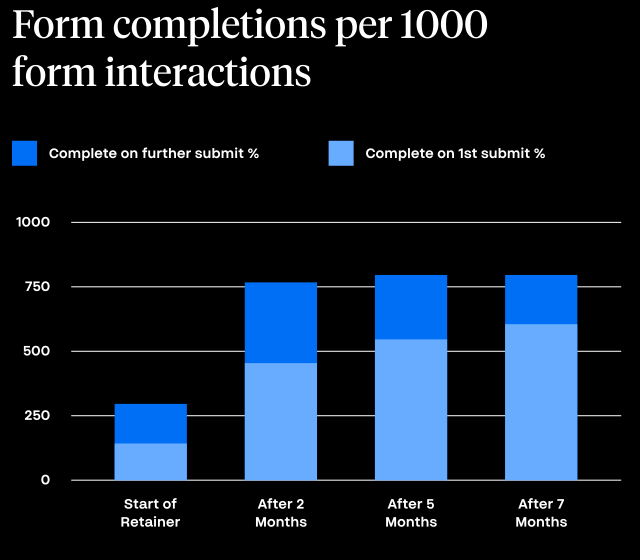
+187%increase in total form submissions
+360%increase in successful 1st attempt form submissions
+6percentage point lift in overall form engagement rate
Our client is a large cybersecurity software provider that helps organizations protect their email ecosystems from threats like phishing, spoofing, and impersonation.
We have happily accommodated their request for anonymity by removing the company name and replacing specific identifying details.
Company Size
Enterprise
Category
Cybersecurity
Services
B2B
Our Work
- CRO
Challenge
High-value offer undermined by friction
Our client, an enterprise cybersecurity software provider, has a unique value proposition that’s hard to beat: A genuinely free, no-risk tool that gives organizations immediate visibility into who is sending email on their behalf and the security of their domains.
Their primary CTA invites you to try their solution for free. This is powerful: it provides instant value to prospects and serves as an on-ramp for other products that help strengthen overall domain and email security.
And yet, despite strong traffic and high CTR, conversion rates remained low. Internally, the cybersecurity company's team believed the offer should be driving far more pipeline than it was. The right audience was reaching the form. The offer resonated. But something was getting in the way — and they couldn’t see what it was. That’s when they turned to Tiller.

Solution
Diagnosing friction & driving momentum
Tiller led a CRO retainer engagement focused on iterative improvements grounded in behavioral data and performance metrics. To collect this data, we used a combination of GA4, form analytics, and click tracking using in-house tools.
Step 1: Establish a Baseline
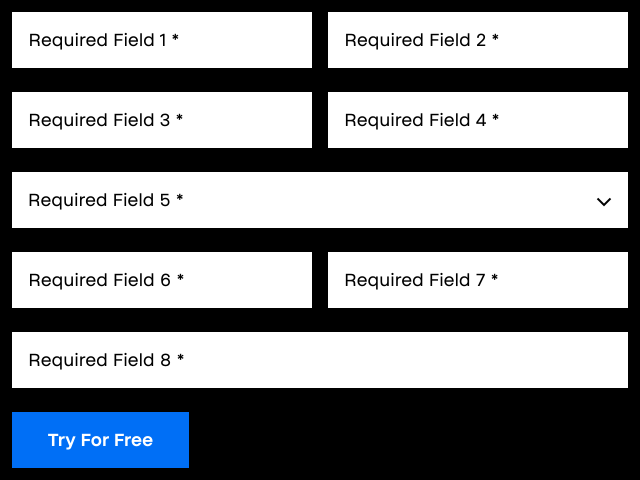
We started by collecting granular user data on the “Try For Free” form. This allowed us to assess:
- Percentage of users engaging with the form
- Rate of attempted submissions
- Rate of successful form completions across all attempts
Completion Path
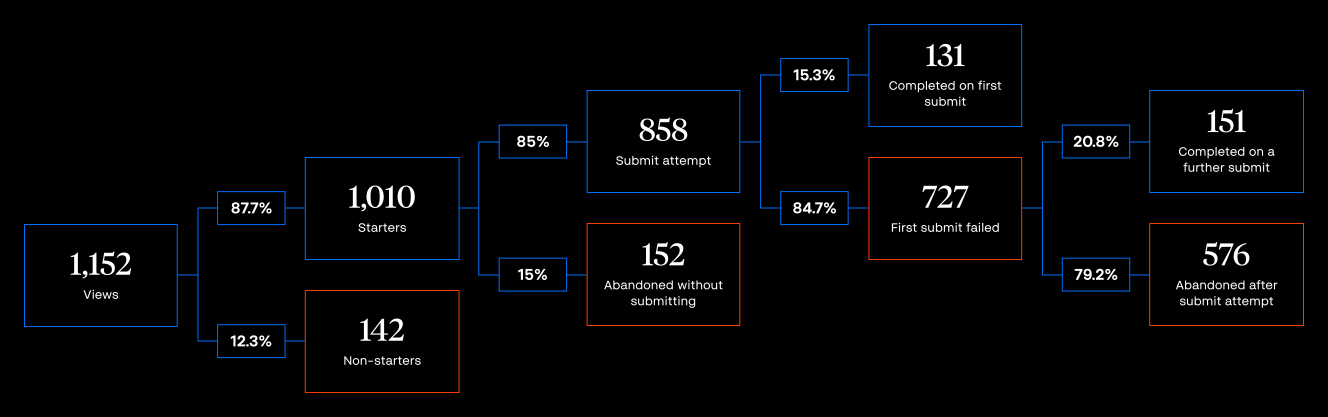

We discovered that the "Try For Free" form had:
- Strong engagement: 1,152 users start the form in an average month.
- High completion rates: 85% of prospects who start the form click ‘Submit,’ outpacing the industry average of 60.85%.
But there was a glaring problem: Only 15.3% of submissions succeeded on the first try. After the first attempt failed, 79.2% of people abandoned the form without trying again.
In other words, for every 1000 people who started the form, roughly 130 successfully submitted on the first attempt, and 150 succeeded on a subsequent submission.
That’s a 28% success rate across all attempts. The form was leaking prospects like a sieve.
We knew the core problem wasn’t the offer or the copy, because engagement would have been lower. The problem was endemic to the form itself.
Step 2: Identify Friction Points
Tiller monitored the form until we had a statistically significant amount of user interaction to identify high-friction issues causing drop-off.
Our analysis uncovered multiple high-friction points within the page, including some unintuitive UI design elements and required form fields that frequently went unfilled.
One required field was skipped by 62.3% of users — a huge issue that always resulted in an error!
Step 3: Targeted Optimizations
With core issues identified, we began to triage solutions. As part of our conversion rate optimization (CRO) services, we:
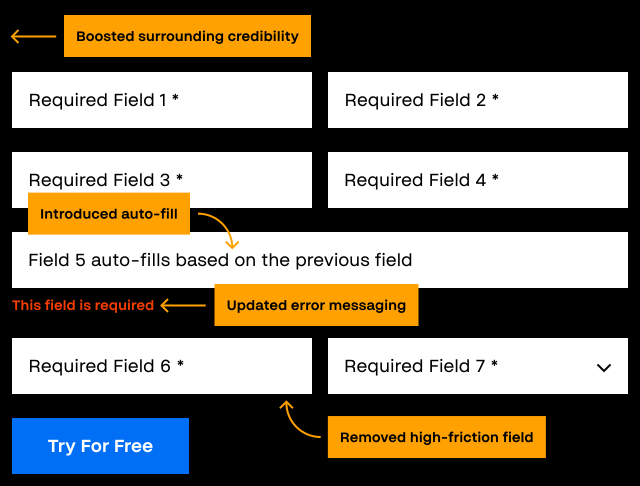
- Removed unnecessary fields to shorten the form and lower cognitive load.
- Custom-coded an autofill solution to dynamically validate an industry-specific field, removing a primary source of error.
- Updated error messaging to offer clearer guidance and reduce abandonment after failed attempts.
- Refreshed peripheral page content and layout to create more context and confidence leading into the form. (Just because engagement is high doesn’t mean it can’t be higher!)
We introduced these improvements incrementally and intentionally, following each round with more data collection to inform future optimizations.
Step 4: Monitor, Test, Iterate
With improvements deployed, we continued monitoring form behavior on a monthly basis.
Seven months post-optimization, we were still seeing sustained increases across every key metric.
| Baseline | 2 months post-CRO | 5 months post-CRO | 7 months post-CRO | |
| Submit Attempt % | 85% | 90.4% | 92.6% | 90.4% |
| Complete on First Submit % | 15.3% | 49.9% | 58.5% | 66.2% |
| Complete on Further Submit % | 20.8% | 71.4% | 66.7% | 67.1% |
Results
Sustainable gains, not one-time wins
Tiller’s CRO efforts didn’t just produce a short-term lift — they drove measurable, compounding gains over time. Through targeted optimizations and ongoing iteration, we helped transform a high-friction user experience into a consistently high-performing conversion engine.
What started as a leaky funnel evolved into a reliable growth channel, with total form completions nearly tripling by month seven. Because improvements were rooted in user behavior and validated over time, the performance gains proved scalable and sustainable.
Form engagement also saw a small, but meaningful lift: the percentage of users who attempted to submit the form rose from 85% to a blended average of 91% — a 6 percentage point improvement that indicates smoother UX and greater user confidence.
Suffering from poor
conversion rates?
Tiller helps you turn website traffic into pipeline